Quantification of anions in water using an improved ion chromatography system

Anion analysis can be performed at several conditions, using various columns on different systems and still be able to meet official requirements. A common approach is isocratic separation with carbonate-bicarbonate eluents, and this example showcase how such analyses can be improved and streamlined with autosampler injections, continuous suppression and protected eluents.

This analysis method for fluoride, chloride, nitrite, bromide, nitrate, phosphate and sulphate, was adhering to the requirements in US EPA 300.1A and could process many samples, standards, blanks and other quality control injections during an overnight sequence without any user intervention. The linearity extended over two orders of magnitude with stable recovery, and the reproducibility was fulfilling all criteria. This method was used by a commercial laboratory to quantify inorganic anions in drinking water and filtered surface water samples collected across USA.

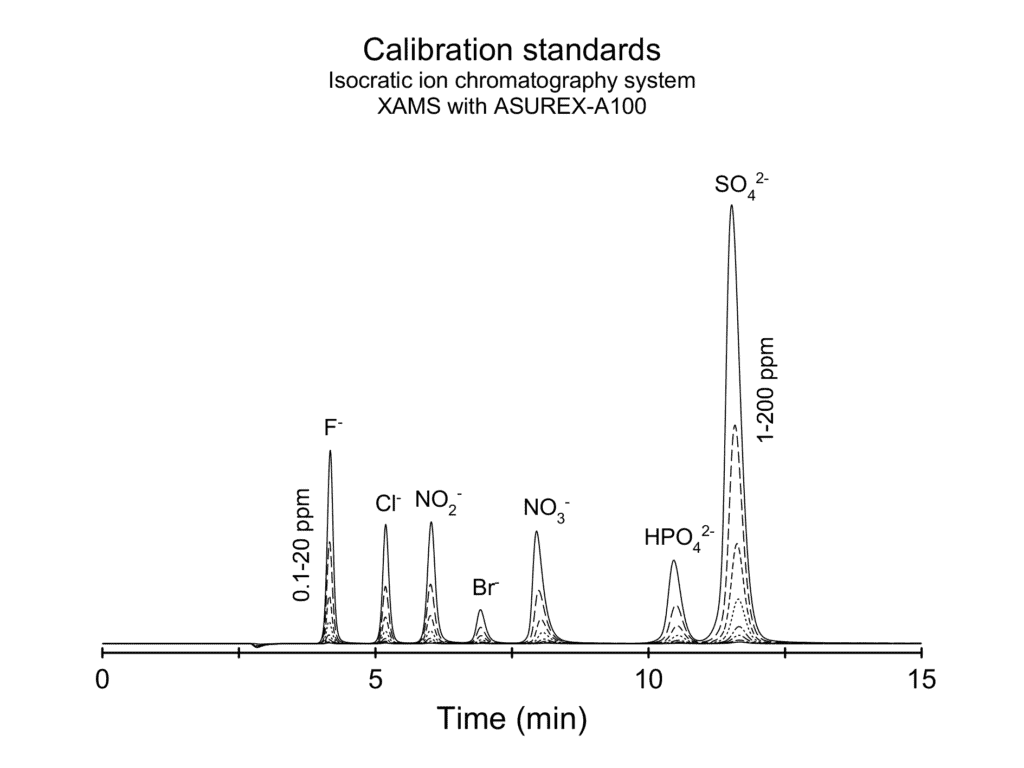
Separation of seven inorganic anions in eight levels of calibration standards on a ICSep AN2 column (250×4.6 mm) using an eluent containing 1 mM Na₂CO₃ and 3.5 mM NaHCO₃ in ultrapure water pumped at 1.0 mL/min at 40 °C. Eluent was protected by EQAX-TC1 trap cartridges for carbon dioxide removal. Background reduced by XAMS suppressor with ASUREX-A100 automatic regenerator. The system was a MembraPure IONUS IC with autosampler controlled by Clarity chromatography software. Injection of 20 µL of F¯ (0.1-20 mg/L), Cl¯ (0.1-20 mg/L), NO₂¯ (0.2-40 mg/L), Br¯(0.1-20 mg/L), NO₃¯ (0.3-60 mg/L), PO₄²¯ (0.5-100 mg/L), SO₄²¯ (1-200 mg/L) in water. Linear correlation coefficient (R²) was 0.9986-0.9998 for the full calibration ranges and recovery was 96.9-106.7% at the centre of the calibration range. Acknowledgements to Jeff Brewer at Advanced Separations (www.advsep.com).

OEM Request

Service inquiry