
Quantification of common anions in beer using a passivated HPLC system

For brewers, ensuring consistent beer quality from batch to batch is essential. Consumers expect the same flavour every time they choose their favourite beer, making analytical testing a key part of brewery quality control.

Among the many parameters monitored, the concentration of common anions is particularly important, as the presence and concentration of these ions can influence both the brewing process and the flavour of the finished beer. High sulfate levels affect the taste of hopped beers, and chloride ions may
contribute to the perceived sweetness. Nitrate and chloride ions can affect the yeast and have a negative impact on the fermentation process. Therefore, accurate quantification of these ions is an important part of analytical testing in both breweries and research laboratories.

Suppressed ion chromatography is typically the technique to accomplish analysis of anions in beer, however, standard HPLC systems can form the basis of the equipment after some modification. Typical system amendments include pump head passivation and exchanging eluent flow lines to PEEK (poly-etyher-ether-ketone), plus addition of a detector for low conductivity levels together with a suitable suppressor.
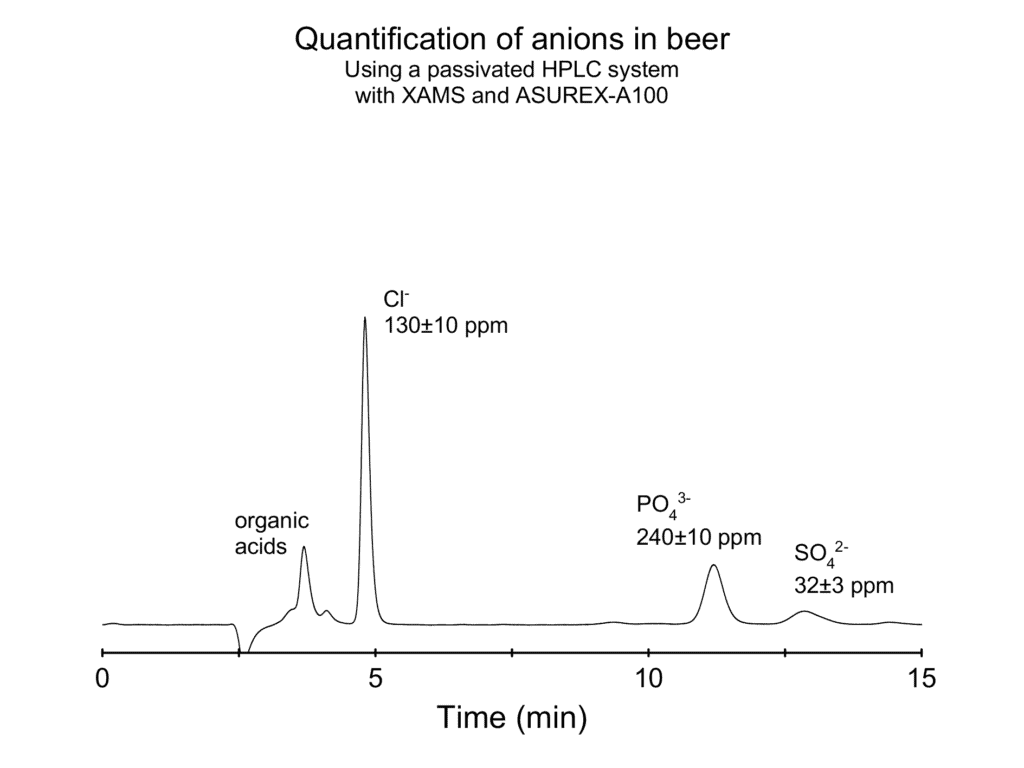
Quantitative analysis of anions in using a Shodex IC SI-90 4E column (250×4 mm) and an eluent containing 1.7 mM Na₂CO₃ and 1.8 mM NaHCO₃ in ultra-pure water pumped at 1.0 mL/min at 25 °C. Background reduced to ~13 µS/cm by XAMS suppressor with ASUREX-A100 automatic regenerator. Eluent pumping and conductivity detection by a passivated Hitachi LaChrom Elite system. Injection of 50 µL sample filtered and diluted 50 times to match the calibration range. Linear six-point calibration curves gave the following concentrations; Cl¯ 130±10 mg/L, PO₄³¯ 240±10 and SO₄²¯ 32±3 mg/L (95% confidence interval). The early eluting organic acids could not be quantified under these conditions due to incomplete separation.

OEM Request

Service inquiry