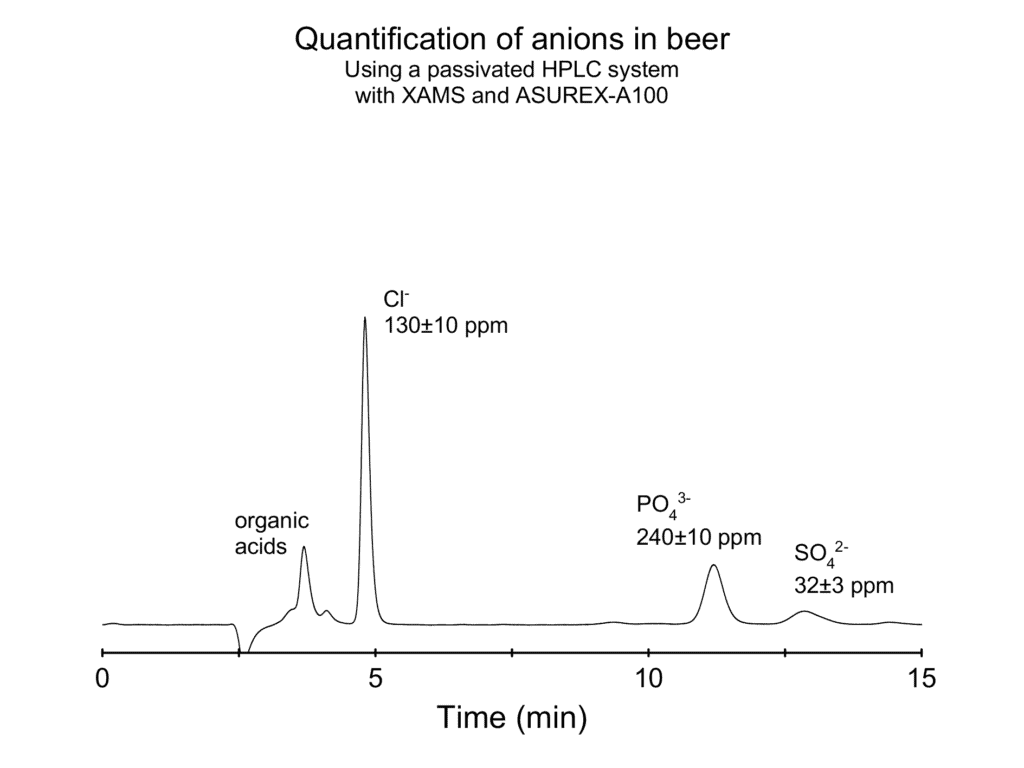
Among the many parameters monitored, the concentration of common anions is particularly important, as the presence and concentration of these ions can influence both the brewing process and the flavour of the finished beer. High sulfate levels affect the taste of hopped beers, and chloride ions may
contribute to the perceived sweetness. Nitrate and chloride ions can affect the yeast and have a negative impact on the fermentation process. Therefore, accurate quantification of these ions is an important part of analytical testing in both breweries and research laboratories.
Suppressed ion chromatography is typically the technique to accomplish analysis of anions in beer, however, standard HPLC systems can form the basis of the equipment after some modification. Typical system amendments include pump head passivation and exchanging eluent flow lines to PEEK (poly-etyher-ether-ketone), plus addition of a detector for low conductivity levels together with a suitable suppressor.