Determination of fluoride ion concentration to monitor biodegradation of perfluorinated acids

Although perfluoroalkyl substances (PFAS) are knowns for their persistence in natural ecosystems, there are certain bacterial strains that can help to decompose them. This published scientific paper studied bacterial degradation of certain perfluorocarboxylic acids (PFCAs) and perfluorosulfonic acids (PFSAs) by including ion chromatography analysis of fluoride ions, set up on a HPLC instrument with added suppressed conductivity detection.

Since defluorination of PFAS molecules cause release of fluoride ions, monitoring of their concentration during microbial cultivation is an important tool to build understanding and potentially enhance bacterial strains that can accomplish such processes. This study analysed fluoride ion concentrations in growth medium ultrafiltrates while simultaneously following accumulation of shortened PFAS species by other analysis methods, allowing the authors to suggest different biodegradation pathways for the two types of perfluorinated acids in the examined bacterial strain that previously had been extracted from contaminated soil.

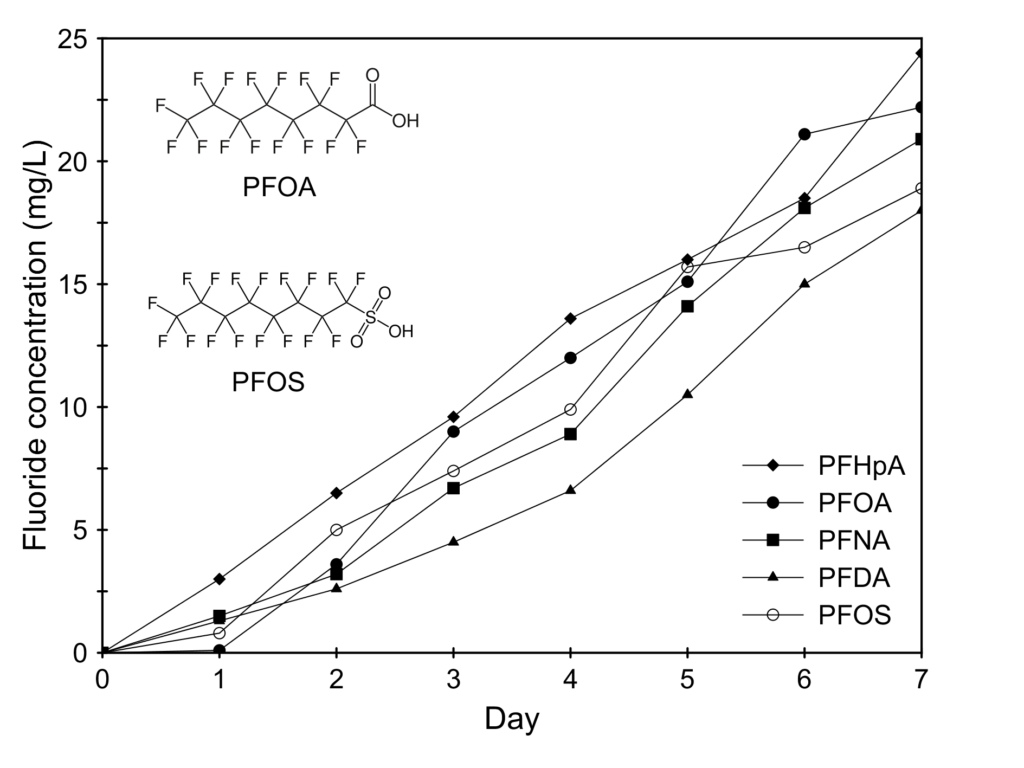
Determined concentrations of fluoride using a Shodex IC SI-90 4E column (250×4.6 mm) with an eluent containing 1.7 mM Na₂CO₃ and 1.8 mM NaHCO₃ in water pumped at 1.0 mL/min. Background reduced by XAMS suppressor with ASUREX-A100 automatic regenerator. System was Shimadzu LC-20 Prominence HPLC system with CDD-10Avp conductivity detector. Samples were ultrafiltrates of liquid mineral growth medium containing Pseudomonas mosselii strain 5(3) where the only carbon source was 250 mg/L of either perfluoroheptanoic acid (PFHpA), perfluorooctanoic acid (PFOA), perfluorononic acid (PFNA), perfluorodecanoic acid (PFDA), or (PFOS). Full investigation available in Toxics 11 (2023) 1001.

OEM Request

Service inquiry