Separation of glyphosate and related herbicides in aqueous samples

Analysis of glyphosate and related phosphonates acting as systemic herbicides is critical for protecting public health, ensuring regulatory compliance, and monitoring environmental safety. Because these chemicals are persistent, polar, and highly prevalent in agricultural ecosystems, detecting them allows management of dietary exposure and long-term health risks.

Environmental sample analysis of trace herbicides often requires mass spectrometry detection to meet quantification limits and therefore relies on hydroxide-based eluents in ion chromatography since they can be suppressed to water. In other instances, for example in the development of new extraction tools for phosphate-containing molecules in aqueous samples, a simple carbonate-bicarbonate eluent can be sufficient, as demonstrated in this example from a published scientific paper.

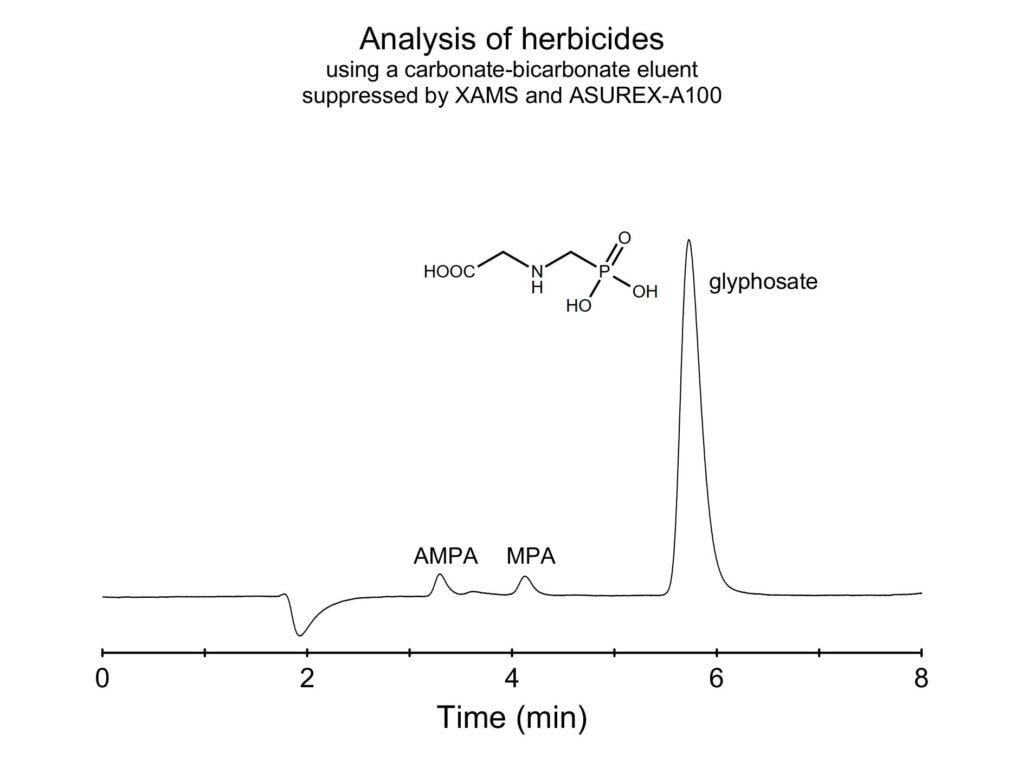
Separation of glyphosate and its degradation products aminomethylphosphonic acid (AMPA) and methylphosphonic acid (MPA) using a Metrosep A Supp 5 column (100×4 mm) and an eluent containing 8 mM Na₂CO₃ and 2.5 mM NaHCO₃ in ultra-pure water pumped at 0.7 mL/min at 35 °C. Background reduced by XAMS suppressor with ASUREX-A100 automatic regenerator. Conductivity detection by a Costech detector. Injection of 100 µL glyphosate sample (100 ppm) while AMPA and MPA were identified from individual standards. Acknowledgements to Dr. Chau Minh Huynh at Umeå University for sharing data acquired for the published scientific paper ACS Omega, 10 (2025) 22412 (doi: 10.1021/acsomega.4c06690).

OEM Request

Service inquiry